
Bit size: how to measure your horse's mouth
A bit size chart by horse type (pony, cob, horse) gives a rough idea, not the size to order. The right size is based on the width of the mouth, from one corner of the lips to the other, plus a margin that depends on the rings. Our guidelines come from a Finnish veterinary study and from bit specialists quoted in the British equestrian press.
Measuring the horse's mouth: string or bit measure
The measurement is taken at the corners of the mouth, where the bit sits. Slide a piece of string or a wooden dowel into the place of the bit, mark with a felt-tip pen where it comes out on each side, then measure the distance laid flat: this is the method described by Horse & Hound and the American retailer SmartPak. A bit measure, a plastic gauge slipped into the mouth, shows the size directly. If the reading falls between two sizes, Horse & Hound recommends taking the larger one.
Does your horse already wear a bit that fits well? Measure that too. Tricia Nassau-Williams, a bitting expert for BETA (the British Equestrian Trade Association), points out, however, that a curved or thick mouthpiece doesn't sit in the same way as a straight one: the same mouth may need different sizes depending on the model.
Reading a bit size: the width of the mouthpiece
The size of a bit is the length of the mouthpiece, measured on the inside, from one ring to the other; the rings don't count. British manufacturers give it in inches (5 inches is 12.7 cm). On our product pages, it is often given in millimetres: sizes 105 to 135 in the Harcour Pro Confort range run from 10.5 to 13.5 cm.
Loose rings: half a centimetre of play at most
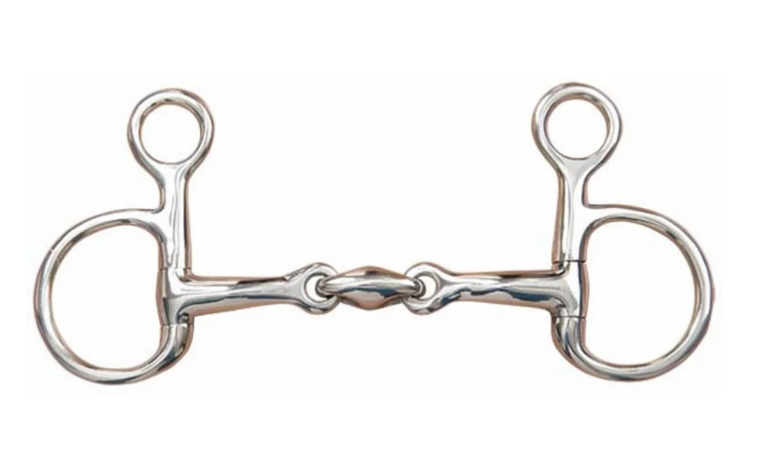
On a loose ring snaffle, the ring slides through the mouthpiece and can pinch the lip. Lindsay Middleton, a bit specialist at Sprenger, limits the gap to 0.5 cm on each side between the corner of the mouth and the ring (Horse&Rider, 2017). Horse & Hound asks for at least 3 mm between the lip and the ring hole, and considers the bit too large if you can see 1.3 cm or more. For our single and double-jointed bits with loose rings, allow the width of the mouth plus 0.6 to 1 cm.
Fixed rings: closer to the lips
With an eggbutt, a D-ring or a full cheek, nothing slides: the bit can fit more closely, as long as it doesn't pinch the corners of the mouth. According to Richard Ramsay, interviewed by the British insurer SEIB, 2 mm on each side is then enough, compared with 5 mm for loose rings. For a 12 cm mouth, choose a 12.5 cm eggbutt bit , and rather 13 cm for loose rings.
The Helsinki researchers (Anttila and co-authors, Frontiers in Veterinary Science, 2022) considered a bit to be the right width if it extended 0 to 10 mm beyond the mouth. According to their study, of 422 horses, 14.9% wore a bit that was too narrow and 10.9% a bit that was too wide.
Horse bit sizes: guidelines for pony, cob and horse
British and American ranges often label their bits Pony, Cob or Full; here are the widths found in our sources.
| Type | Mouthpiece width | Source |
|---|---|---|
| Pony | 11.5 cm | STC |
| Cob | 12.5 cm | STC |
| Horse (Full) | 13 to 14 cm | SmartPak; 13.5 cm at STC |
| Draught horse | up to approximately 18 cm (7 inches) | SmartPak |
| Mouths measured on 554 horses and ponies | 9.5 to 16.5 cm, 13.1 cm on average | Anttila et al., 2022 |
The STC sizes are those of an eggbutt and full cheek bit sold by The Vet Shed. These labels are only a guide: in the Finnish study, ponies had the smallest mouths and Finnhorses the largest. Horse & Hound also advises against relying on the old British rule of thumb (4.5 inches for a pony, 5 for a horse, 5.5 for a draught horse), as mouths vary too much.
Among our bits for horses and ponies, the BR pony double-jointed loose ring snaffle comes in 9.5 and 10.5 cm.
Mouthpiece thickness: the space between the tongue and the palate
Thickness ranges from about 12 to 23 mm. Tricia Nassau-Williams advises measuring it with callipers, at the widest point of the mouthpiece, near the ring. In her view, 12 to 14 mm is very thin, 16 mm the most common, and 20 mm very generous.
Thicker doesn't mean milder, points out Country & Stable. The Helsinki study found an average of 14 mm of space for the bit between the tongue and the palate, ranging from 5 to 22 mm depending on the horse. Of the 43 horses for which the comparison was possible, 12 were wearing a bit that was too thick.
The two-finger test, suggested by Lindsay Middleton, gives an idea of this space. Slide your index and middle fingers, held together, onto the bars, the toothless gap where the bit sits: if they are clearly squeezed by the jaws, choose a 14 to 16 mm mouthpiece; with little or no pressure, 16 to 18 mm. If it's too thick, the bit presses on the palate, and the horse may toss its head, open its mouth or snatch at the reins.
In our range, the soft contact double-jointed ring bit has a 12 mm mouthpiece and the BR pony snaffle a 14 mm mouthpiece. The 22 mm Pro Confort eggbutt needs a mouth with plenty of room.
Bit too small or too large: the signs
Too narrow, the bit squeezes the lips and cheeks, with the risk of cutting the corners of the mouth. Too wide, it slides from side to side and can injure the inside of the mouth. The second problem is probably the more common one, according to Tricia Nassau-Williams, because many riders size up thinking they are giving the horse more comfort.
When working, a poorly fitting bit shows in head movements, snatching at the reins or excessive salivation (Country & Stable). An equine dentist can also help: among other things, they examine the tongue and the height of the palate, Richard Ramsay points out. To prevent rubbing, the silicone comfort bit guards are with our bit accessories.
Adjusting the height: the wrinkles at the corners of the mouth
In a V-shaped jaw, the height of the bit changes its effective width: Tricia Nassau-Williams therefore advises adjusting the height before judging the width. For a snaffle, the classic guideline is one or two small wrinkles at the corner of the mouth; a curb bit doesn't create a wrinkle and must not touch the teeth (SmartPak). Country & Stable notes that bit specialists are moving away from the wrinkle rule and relying instead on the natural ridges of the palate. Keep the same height on both sides.
Stainless steel, copper, resin, rubber or leather
Stainless steel is probably the most common material; its great advantage is its strength, according to Your Horse. Copper and its alloys, such as the Cuprion of the BR Waterford bit or the rollers of the Privilège bit, are reputed to encourage horses with a dry mouth to salivate; copper can, however, become pitted over time (EquiSearch). The resin bits from Happy Mouth, such as the HFI Spanish bit, are apple-flavoured. Your Horse advises keeping an eye on wear on plastic and rubberbits, as a chewed mouthpiece can cause injury. Leather covers the mouthpiece of the Lamicell Verdun bit.
A horse that seems to reject metal is often reacting to an unsuitable size or shape, notes Your Horse. So measure before you order: we accept returns of unused items within 14 days, in their packaging, and a bit that has been tried in the mouth no longer counts as unused. If in doubt, call us or come in with your old bit to 432 avenue de Paris, Saint-Lô.
Frequently asked questions
How do I measure a bit I already have?
Lay it flat on a rigid ruler rather than a tape measure, and measure the mouthpiece between the inner edges of the rings. On a loose ring snaffle, measure from the inside of the holes the rings pass through (Horse & Hound). Also note the thickness at the base of the ring to compare with our product pages.
My horse is between two sizes: which one should I choose?
With a bit measure, Horse & Hound recommends the size up. Then take the rings into account: an eggbutt or full cheek bit sits close to the lips, whereas a loose ring snaffle needs 3 to 5 mm of play on each side. Don't go wide “to be safe”: a bit that is too large slides and can cause injury.
What size bit for a pony?
Bits labelled Pony are around 11.5 cm, but SmartPak mentions pony bits going down to about 7.5 cm. So measure yours with string, then add the margin that suits the rings; our BR pony double-jointed ring snaffle comes in 9.5 and 10.5 cm.
Should you review the bit size as the horse gets older?
Yes. In horses aged 5 to 29 measured by the University of Helsinki, mouth width and the distance between the jaws increased with age. The authors therefore recommend checking the fit of the bit regularly. Measure again with string from time to time, and as soon as your horse's behaviour changes.