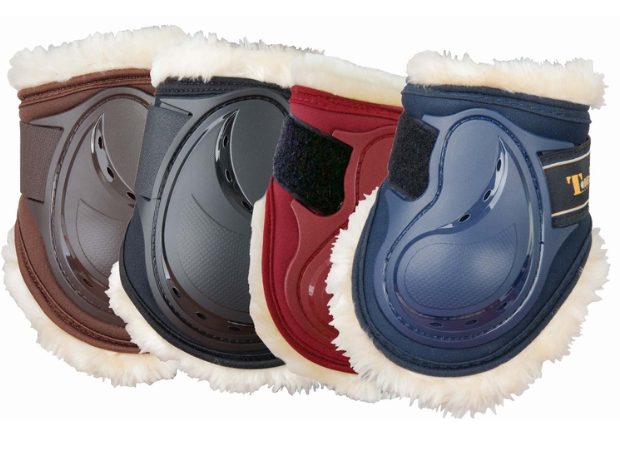
Horse boots: open-front, closed or fetlock boots
Open-front tendon boots protect the back of the tendon, where the hind leg strikes, and leave the front of the cannon uncovered. The horse feels the pole if he touches it, which encourages him to stay attentive. This is the usual protection for show jumping. The HKM Breath, the Lamicell Élite and the BR Ultimo are on the page open-front tendon boots, along with the rest of our selection.
Closed tendon boots wrap around the whole cannon. They are suited to flatwork and hacking out, where a knock can come from any side. The V22 boots also protect the knee.
On the hind legs, fetlock boots cover the inside of the fetlock, which is exposed to strikes from the opposite leg. HKM, Lamicell, Zandona, Rider and T de T all make them, such as the HKM Basic or the T de T Design Mouton.
Overreach boots
Overreach boots wrap around the coronet and heels of the front legs. They stop a hind leg that steps well under from cutting the heels or pulling off a shoe. Closed overreach boots, such as the thin and thick Privilège models, are pulled on over the hoof and cannot come undone mid-effort. Velcro models, such as the T de T rubber overreach boot, are easier to put on. Find them all in our section overreach boots for horses.
Fitting and care
Fasten boots firmly without squeezing: you should be able to slide a finger under each strap. The fastenings close towards the back of the leg so they do not catch. Too high, a boot restricts the knee; too low, it rubs on the fetlock.
Remove boots as soon as the session ends, as the leg heats up under neoprene. Brush or rinse them before any sand can settle between the boot and the skin, then leave them to air-dry away from any heat source.




 29,90 €
 15,95 €
 19,90 €
 109,90 €