Blog › Advice › Body protector or airbag vest
Guide · Rider equipment
Body protector or air vest: how to choose?
Body protectors and air vests do not protect in the same way, and for cross-country they are often worn together. Here is how to make sense of it.
The body protector: the EN 13158 standard
A body protector, or cross-country vest, is made of foam. It absorbs impacts to the back, ribs and chest in every fall, with nothing to trigger. In Europe, it is tested to the NF EN 13158 standard, which classifies it into three levels:
Level 1
Light protection, for professionals in specific conditions.
Level 2
Basic protection, for low risks. This is the level required in horse racing.
Level 3
The most protective. The benchmark for cross-country, eventing and everyday riding.
The level and the year of the standard are shown on the label and in the instructions. For everyday use, choose level 3.
The air vest: the NF S72-800 standard
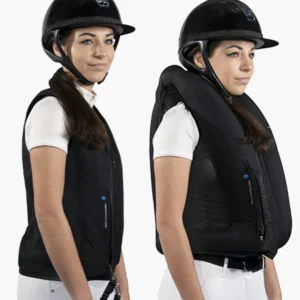
An air vest is attached to the saddle by a strap. When the rider falls, the strap pulls on the trigger and a gas cartridge inflates the vest in a fraction of a second. It protects the neck, back, ribs and abdomen. Since 2022, the French standard NF S72-800 has governed riding air vests (inflation speed, protected area, resistance).
After each deployment, the cartridge must be replaced. Each brand has its own: Hit Air 50 or 60 cc, Hélite, Horse Pilot, Segura. Check the capacity specified by the manufacturer.
Do you need both for cross-country?
In eventing, a body protector is compulsory for the cross-country phase. An air vest is permitted, but it is worn in addition to the body protector, not instead of it.
Rules vary by discipline and by year: always check the FFE rules for your competition.
For training and hacking, an air vest on its own is a common choice. Many cross-country riders wear an air vest over their body protector.
Choosing the right size
A body protector should:
- cover the upper back up to the base of the neck, and come down to the waist;
- not touch the saddle when you are seated: a body protector that is too long rides up and pushes you forward;
- fasten without being loose, while still letting you breathe and turn your upper body.
Try it on with the clothes you will wear when riding. In the shop, we will help you adjust the fastenings.
Care and replacement
After a heavy fall, the foam of a body protector may retain the mark of the impact. Have it checked or replace it, following the manufacturer's advice. An air vest should be checked before every ride: cartridge screwed in properly, strap in good condition.
Body protectors and airbag vests in the shop
See the whole range-

-
Hit Air complete airbag vest 3
From 529,00 €Select options This product has multiple variants. The options may be chosen on the product page -
Hélite ZIPIN2 Airbag Vest
From 495,00 €Select options This product has multiple variants. The options may be chosen on the product page